
The aardwolf is a highly specialised carnivore and appears to be unable to feed efficiently on anything other than social insects (Anderson et al. 1992). It also appears to be the only African ant- or termite-eater that can tolerate the terpene defence secretions of Trinervitermes soldiers (Richardson and Levitan 1994). Although both the aardwolf and bat-eared… Continue reading Aardwolf: Association with other species
Category: Aardwolf (Proteles cristata)
Aardwolf: Physical Description
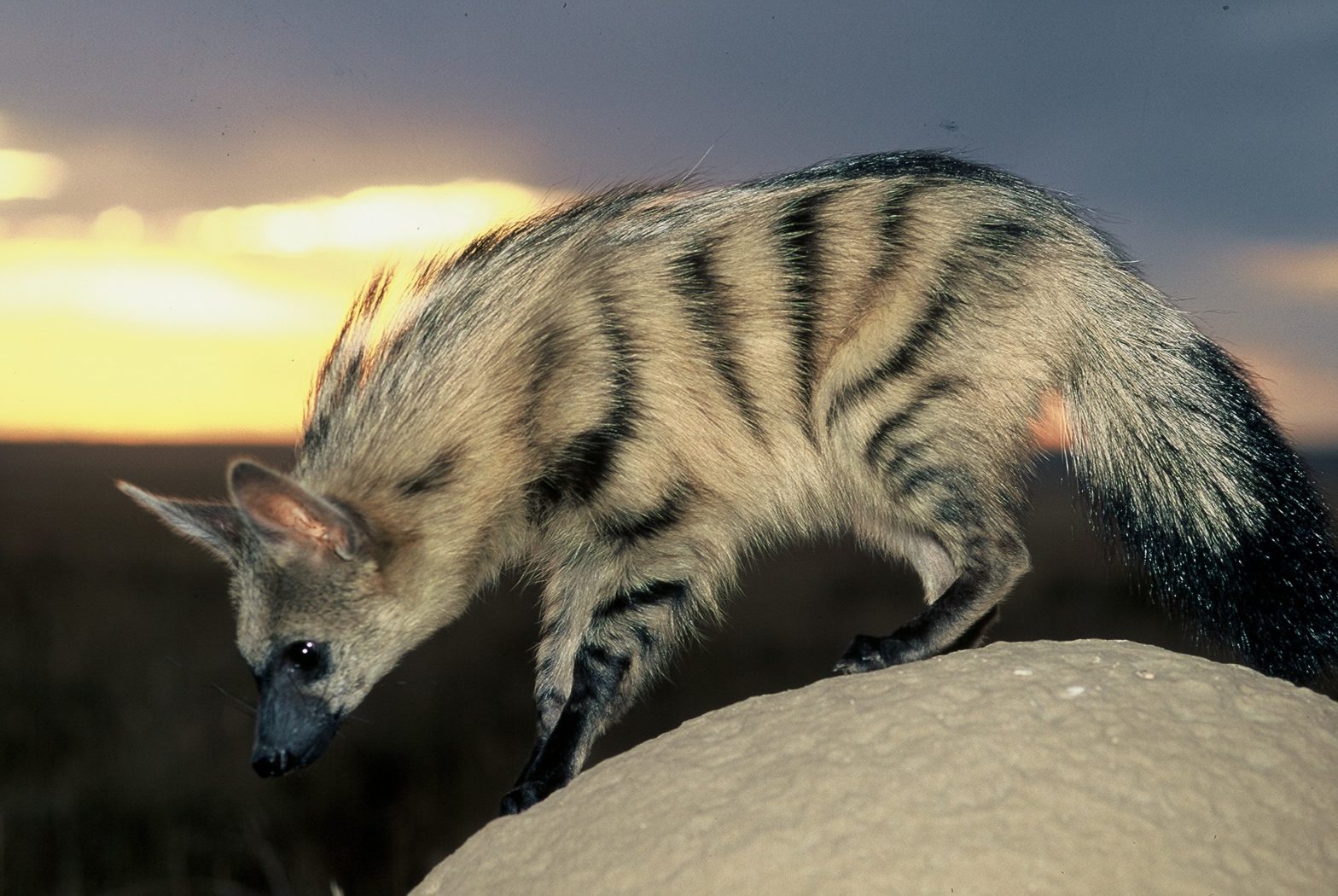
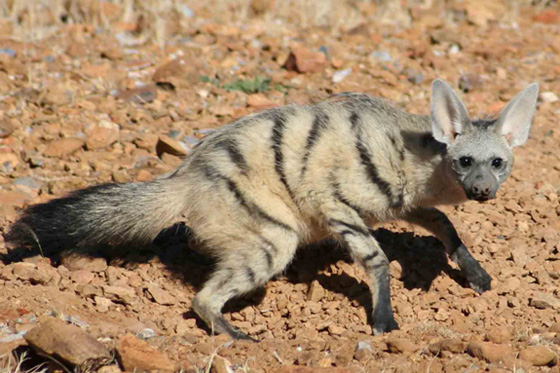
The aardwolf is slightly larger than a jackal or a fox and has long, slender legs and a long neck. Its sloping back is not as pronounced as in the three other hyaena species. The background colour of the body varies from yellowish-white to rufous. The throat and underparts are paler and can reach a… Continue reading Aardwolf: Physical Description
Aardwolf: Diet and Foraging

Throughout its distribution range the aardwolf feeds primarily on one local species of nasute harvester termite (genus Trinervitermes). The preferred species are T. bettonianus in East Africa (Kruuk and Sands 1972); T. rhodesiensis in Zimbabwe and Botswana (Smithers 1971); and T. trinervoides in South Africa (Cooper and Skinner 1979, Richardson 1987a). In South Africa the diet is supplemented in winter by the… Continue reading Aardwolf: Diet and Foraging
Aardwolf (Proteles cristata)
Body mass: approximately 10 kgThe aardwolf’s favourite food is insects, especially termites, which they help to control. Aardwolves cannot kill livestock, yet many aardwolves are killed each year because people believe they kill lambs. They are also killed indirectly through insecticide spraying. Aardwolves are family oriented, with males and females living together in a territory. … Continue reading Aardwolf (Proteles cristata)
Aardwolf: Distribution and Habitat
Aardwolves occur solely on the continent of Africa. There are two separate populations. One population is found in southern Africa (including the countries of South Africa, Namibia, Botswana, Zimbabwe, southern Angola, southern Zambia, and southwestern Mozambique). The other northern population ranges from central Tanzania through northeastern Uganda, Kenya, Somalia, along the coast of Ethiopia and… Continue reading Aardwolf: Distribution and Habitat
Aardwolf: Social Behavior
The aardwolf is socially monogamous, a mated pair occupying a perennial territory with their most recent offspring. The offspring stay in their natal territory for one year, and disperse around the time when the next litter is born. Territories are fiercely guarded and range in size from one to four km², the size being determined… Continue reading Aardwolf: Social Behavior
Aardwolf: Reproduction
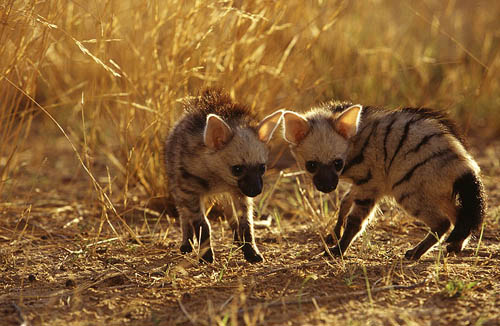
In the North Cape Province of South Africa females come into pro-oestrus during the last weeks of June (mid-winter). Mating usually takes place during the first two weeks of July. The aardwolf is highly promiscuous with dominant males often gaining copulations with the females of subordinate males in neighbouring territories. Copulation may last up to… Continue reading Aardwolf: Reproduction
Aardwolf: Status and Conservation
Status Although there is little information from most northern range states, the overall status of the aardwolf currently can be described as Lower Risk: Least Concern (IUCN, 1996, appendix 6). Threats and Conservation Although the aardwolf may be harvested as a food source and purposefully or accidentally killed in predator control programs, these mortalities appear… Continue reading Aardwolf: Status and Conservation