
Spotted hyaenas in most parts of Africa give birth at any time of year to litters containing one or two cubs, although triplet litters are occasionally reported as well (Frank et al. 1991; Wahaj et al 2007). Females may give birth at the communal den or in a private birth den (East et al. 1989,… Continue reading Spotted Hyaena: Reproduction
Category: The Living Hyaenas
Brown Hyaena: Status and Conservation

Because it is often overlooked, numbers and distribution records may in fact underestimate its distribution and population size. Given this proviso, the results of the questionnaire survey administered by the Specialist Group, and an evaluation of published information and different surveys, suggest that a tentative estimate of the total worldwide population size is at a… Continue reading Brown Hyaena: Status and Conservation
Striped Hyaena: Social Behavior

Almost invariably described as solitary in Africa, a recent study by Wagner (2006) in Kenya study found that striped hyaenas do frequently rest in pairs and occasionally in groups of up to four individuals. These groups never include more than one adult female. Foraging is strictly solitary, beyond mothers with cubs, and even though a… Continue reading Striped Hyaena: Social Behavior
Aardwolf: Association with other species

The aardwolf is a highly specialised carnivore and appears to be unable to feed efficiently on anything other than social insects (Anderson et al. 1992). It also appears to be the only African ant- or termite-eater that can tolerate the terpene defence secretions of Trinervitermes soldiers (Richardson and Levitan 1994). Although both the aardwolf and bat-eared… Continue reading Aardwolf: Association with other species
Striped Hyaena: Physical Description
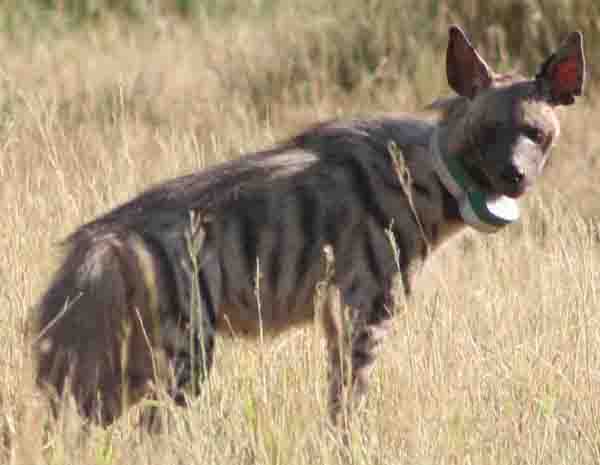
The striped hyaena is a medium-sized carnivore with overall appearance reminiscent of a dog. It has a back sloping downwards towards the tail, and black vertical stripes on the sides. Its general colour is pale grey or beige. It has a black patch on the throat, five to nine more or less distinct vertical stripes… Continue reading Striped Hyaena: Physical Description
Aardwolf: Physical Description
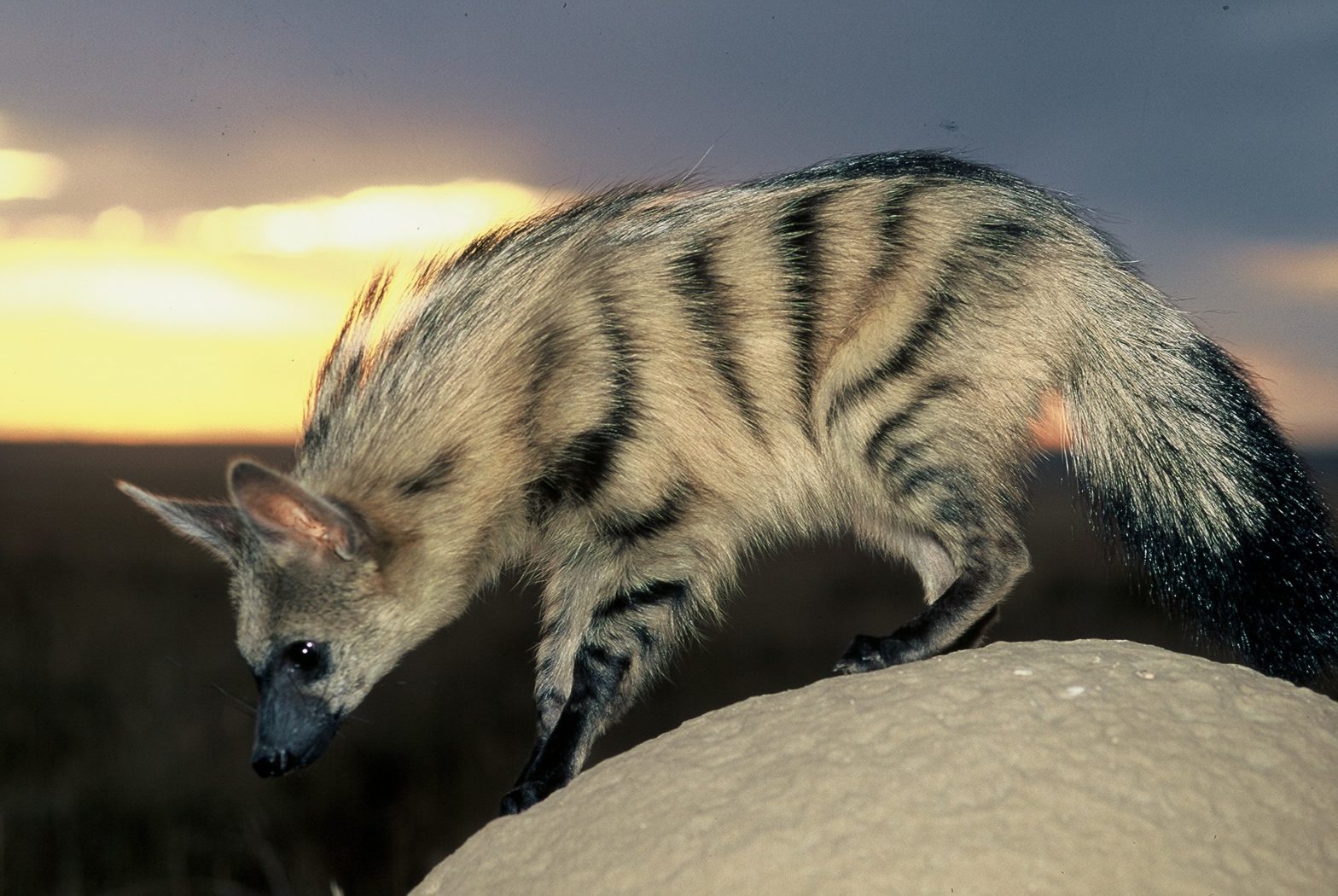
The aardwolf is slightly larger than a jackal or a fox and has long, slender legs and a long neck. Its sloping back is not as pronounced as in the three other hyaena species. The background colour of the body varies from yellowish-white to rufous. The throat and underparts are paler and can reach a… Continue reading Aardwolf: Physical Description
Spotted Hyaena: Social Behavior

The spotted hyaena is one the most highly gregarious of all carnivores; it lives in groups containing up to 90 individuals, and exhibits the most complex social behaviour. These animals live in social groups called clans that defend group territories. The society is characterised by a strict dominance hierarchy. The rank ordering among the adult… Continue reading Spotted Hyaena: Social Behavior
Aardwolf: Diet and Foraging

Throughout its distribution range the aardwolf feeds primarily on one local species of nasute harvester termite (genus Trinervitermes). The preferred species are T. bettonianus in East Africa (Kruuk and Sands 1972); T. rhodesiensis in Zimbabwe and Botswana (Smithers 1971); and T. trinervoides in South Africa (Cooper and Skinner 1979, Richardson 1987a). In South Africa the diet is supplemented in winter by the… Continue reading Aardwolf: Diet and Foraging
Striped Hyaena: Association with other species
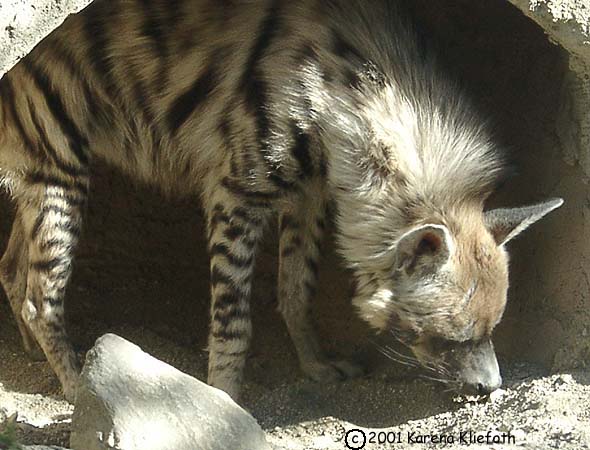
In Israel the striped hyaena may encounter wolves, red foxes and caracals at carcasses. On a one-to-one basis it is dominant over the wolf, but a group of four wolves has been observed driving a single hyaena from a carcass (H. Mendelssohn unpublished data). A caracal may drive a subadult striped hyaena away from a… Continue reading Striped Hyaena: Association with other species
Brown Hyaena: Physical Description
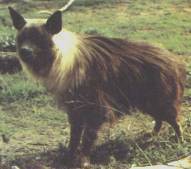
This medium-sized, dog-like animal has long forelegs and well developed forequarters, but weak hindquarters and a sloping back. The pelage is long, shaggy and dark brown to black except around the neck and shoulders, which are white. The underparts are light coloured, and the lower forefeet and hindfeet have white stripes. The ears are long… Continue reading Brown Hyaena: Physical Description