

 Print this page
IUCN/SSC Hyaena Specialist Group Publications/Reports
- 3.1: Action Plan Executive Summary
- 3.2: IUCN Action Plan (full text PDF)
- 3.3: Bibliography for Action Plan (pdf)
Status Survey and Conservation Action Plan: Hyaena: Executive Summary
Gus Mills
(from: http://iucn.org/themes/ssc/pubs/hyaenaen.htm )
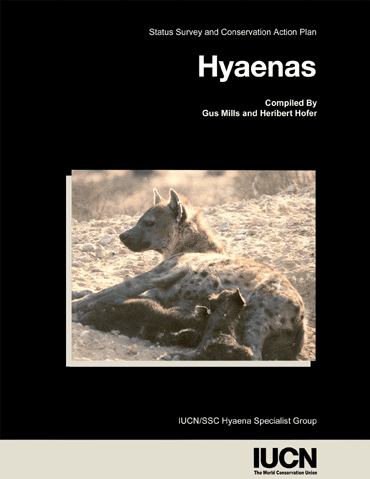 This Action Plan deals with the smallest number of species of any of the other IUCN Action Plans; namely the four living species of the carnivore family the Hyaenidae: the striped hyaena (Hyaena (Hyaena) hyaena), the brown hyaena (Hyaena (Parahyaena) brunnea), the spotted hyaena (Crocuta crocuta), and the aardwolf (Proteles cristatus). Notwithstanding their low species diversity, hyaenas are unique and vital components of most African and some Asian ecosystems. Being large carnivores they clash with the interests of humans to a greater extent than do many other groups of animals. Perhaps the most important challenge facing those of us committed to the conservation of this group of animals is to overcome the very strong negative feelings many people have towards hyaenas.
Until they are viewed in a more positive light it will be difficult to effectively implement management plans for hyaenas.
To achieve our objective we have addressed what we consider to be the most important issues in hyaena conservation in 11 chapters plus six appendices and a comprehensive bibliography. The introductory chapter provides a synopsis of the Action Plan. In chapter 2 the taxonomy and systematics of living hyaenids is reviewed. It concludes that: a) the aardwolf should be included in the Hyaenidae family; b) the brown hyaena and striped hyaena are each other’s closest relative; c) the case for subspecific distinction for the aardwolf is sound because of its disjunct distribution; d) the subdivision of striped hyaena into five subspecies should be maintained, although this needs to be reviewed.
Chapter 3 gives summaries of the major ecological and behavioural characteristics of each species. This is done to give the reader a basic insight into the biology of each and to glimpse at the complexities of their societies. In chapter 4 the distribution of the four species is described, and in chapter 5 population assessments, threats and the conservation status of each species are reviewed on a country by country basis; fundamental information is needed before any kind of conservation action can be taken. Much of the information in chapters 4 and 5 was obtained through a questionnaire survey circulated to over 250 prospective respondents, who were chosen because of their knowledge of the animals and/or local conditions in the distribution range of each species.
The species accounts are followed by chapter 6 on the management of hyaenas in protected areas. This chapter is particularly relevant to the spotted hyaena as this species is most dependent on large conservation areas for its long term survival. Chapter 7 addresses the management of hyaenas outside conservation areas, where they frequently live in close contact with people; an important subject demanding innovative solutions. Survey and census techniques are reviewed in Chapter 8 because distribution and status surveys of hyaenas in many areas are badly needed. Chapter 9 addresses the question of captive breeding of hyaenas and analyses the role this can play in the conservation of the family members.
In light of the distorted public perception of hyaenas, chapter 10 on education and public awareness is of particular importance, as it provides some guidelines to rectify this situation.
The final chapter (11) is the most important one. It discusses appropriate conservation approaches and suggests projects that could enhance the conservation status of the various members of the family. Of course discussing the actions is one thing, implementing them is quite another. It is up to the members of the Hyaena Specialist Group in conjunction with governments, conservation bodies in the relevant countries, NGOs, local communities, and others to initiate and implement the necessary projects and actions to improve the conservation status of these fascinating and important animals.
Appendix 1 is a preliminary Population and Habitat Viability Analysis (PHVA) for hyaenas. In this analysis the results of a study using simulations of population persistence are presented to asses the impact of various human actions on hyaena populations. Appendix 2 gives scientific names of mammals mentioned in the text, Appendix 3 lists the Hyaena Specialist Group Members, Appendix 4 lists the respondents to the questionnaire survey, Appendix 5 reprints the questionnaire for the survey and Appendix 6 describes the IUCN Red List categories. Finally, the Action Plan ends with a hyaena bibliography including all references cited in the text.