

 Print this page
What IS a Hyaena?
Over the course of evolutionary time, the family Hyaenidae has contained roughly 100 different species, occupying a wide array of ecological niches. However, the vast majority of these species exist today only in the fossil record. Although most people think of hyenas as large, dog-like creatures with adaptations for cracking bones, this definition is inadequate because some extinct hyenas were much more like modern mongooses or civets than dogs, and many ancient forms had no special ability at all to crack bones. In fact, hyaenas are more closely related to cats than to dogs. Furthermore, modern aardwolves weigh only about 10 kg, and they have no special morphological adaptations at all for cracking bones. Hyaenids, both living and extinct, are distinguished from other mammalian carnivores by a suite of craniodental features, the most important of which are the structure of particular boney elements in the middle ear and specific characteristics of the deciduous dentition (the “baby teeth”). In their monograph on the taxonomy and systematics of the Hyaenidae, Werdelin & Solounias (1991) include as members of the hyena family all species possessing a posteriorly expanded ectotympanic bone and a reduced caudal endotympanic.
Hyaenas, both living and extinct, can be identified by the suite of cranial characteristics, illustrated below. The skulls of extant hyaenids lack alisphenoid canals, and their auditory bullae are divided, although the septum is not easily visible. Furthermore, in contrast to other mammalian carnivores, hyaenids have no baculum (penile bone).
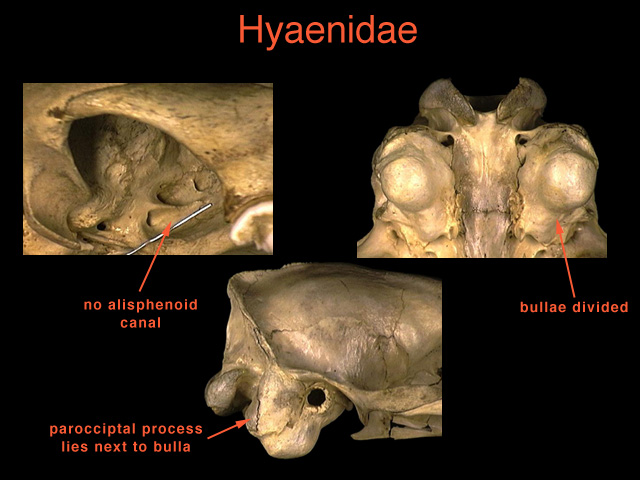
Illustration by Dr Phil Myers, University of Michigan, taken from the Hyaenidae technical characters page on the Animal Diversity Web (ADW). 
Skeleton of a modern spotted hyaena from http://laelaps.wordpress.com/.
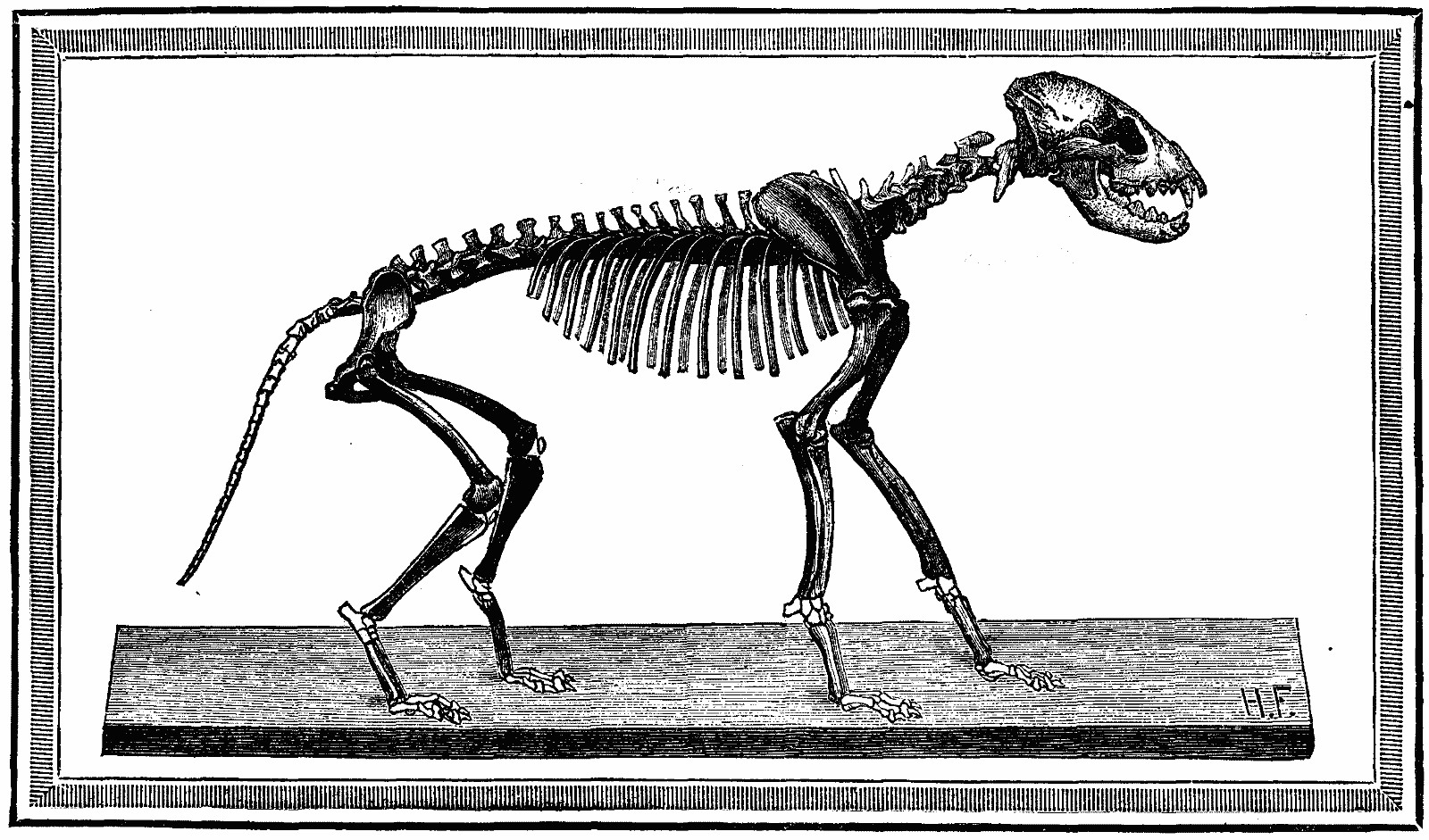
Skeleton of a cave hyaena (Crocuta spelaea) from the grotto of Gargas, a cave in the Pyrenees.

Skeleton of an extinct short-faced hyaena (Pachycrocuta brevirostris) from Zhoukoudian, China.